

The space between independence and being held
When you love your freedom but still long to be looked after

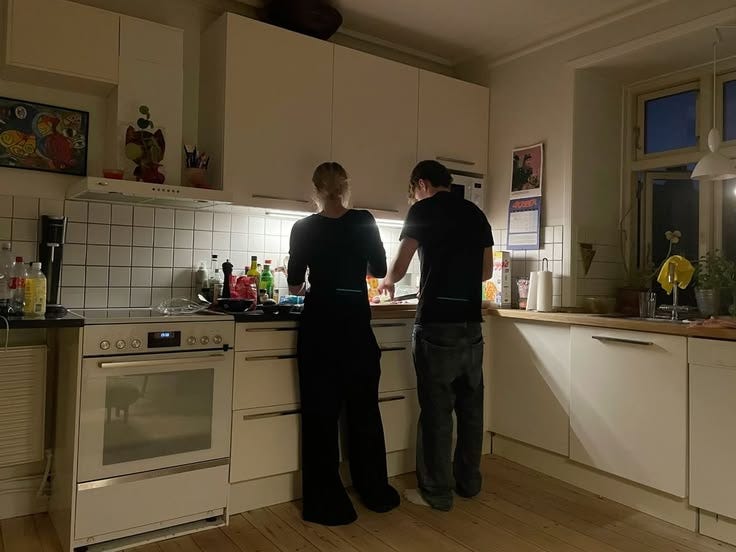
There is a particular kind of happiness that arrives when you finally stop waiting for someone else to make your life feel whole. It’s quiet, deep, and strangely stabilising. You realise you can go to dinner alone, travel alone, make decisions alone, sleep alone, build a life alone—and not feel like you are missing yourself. And yet, even in that steadiness, there can still be a softer longing underneath it all. A longing not for rescue exactly, but for relief. For someone else to hold the thread sometimes. For someone to handle things. For someone to notice, to step in, to make a decision, to take care of you in the simple, ordinary ways that let your nervous system unclench.
I’ve now been almost 8 months single (first time in my adult life), and while I’ve been happier than in many years, I’ve also had those nights when you just really want to have someone right there with you and talk about your day, crash out and they’ll help you to pick yourself up, dance around the living room, make food or order in, decide things together, someone to rely on (and someone to fix that lightbulb). I’ve felt like wanting someone for countless mornings, mid-day when I’ve wanted to tell about that one annoying thing at work, or how I messed something up and needed to hear someone to say that it’s all going to be okay.

What makes this feeling so hard to talk about is that we are often taught to frame it as an either/or. Either you are fiercely independent and therefore should not want anything from anyone, or you are deeply relational and therefore should not be comfortable on your own. But real life is messier than that. You can be profoundly happy alone and still want a partner, a lover, a friend, or a safe person who says, “Don’t worry, I’ve got it.” You can love your own company and still crave the experience of being considered, anticipated, and cared for. You can feel proud of the life you’ve built and still want someone to take some of the weight off your shoulders. That does not make you inconsistent. It makes you human. And ultimately it indicates the deeper desire to relate to someone, build the life you are dreaming of with someone.
Sometimes that longing has nothing to do with romance in the glossy, idealised sense. Sometimes what you are really craving is nervous-system relief. You want someone who remembers the appointment, handles the admin, opens the jar (I cannot buy wine bottles with normal corks at the moment because I cannot for the life of me get them open myself), books the thing, notices when you are tired, and makes life feel less like a solo performance of competence. For many women, especially those who have spent years being the responsible one, the emotionally aware one, the one who keeps things moving, that craving can feel almost embarrassing. But it is not childish to want to be held in ordinary ways. It is not regressive to want support. It is not weak to want a relationship where you do not have to be the one doing everything, emotionally and practically, all the time.
And this is where the deeper work lives: learning how to hold your independence and your longing without shaming either one. The happy-single part of you is not lying. She really does love her life. She likes her space, her freedom, her momentum, her ability to choose herself. The softer part of you is not needy in a bad way. She is pointing to a very real desire for attunement, rest, and shared responsibility. The goal is not to silence one part so the other can win. The goal is to become the kind of person who can say, “I am deeply content on my own, and I also want to be cared for,” without immediately translating that into self-doubt.
That translation is usually where the pain gets tangled. Because many of us were taught that wanting care makes us less self-sufficient, less evolved, less “healed.” But wanting to rely on someone sometimes is not a failure of healing. It is often a sign that your system is ready for interdependence instead of constant self-protection. The deeper question is not, “Why do I want this?” The deeper question is, “Can I desire support without abandoning myself in the process?” Can I ask for help without making it mean I’m incapable? Can I receive care without making it mean I’m not strong? Can I be open to partnership without turning it into a verdict on my worth?
When you understand the shape of your desire, you stop pathologising it. You stop calling yourself dramatic for wanting care or being close to someone, or just wanting someone. What you actually want goes deeper than that and it’s often forgotten. You stop judging yourself for craving steadiness, when your nervous system may simply be exhausted from always being on. And you begin to see that the fantasy of someone taking over is sometimes less about dependence and more about collapse: the fantasy that, just for a moment, you would not have to think, decide, manage, or anticipate. You could simply be looked after.
Of course, there is a difference between healthy support and giving your power away. The work is not to find someone to become your parent. It is to get honest about where you are over-functioning because you’ve had to, and where you are longing for a relationship that feels collaborative, safe, and easing rather than draining. Mature love does not erase your agency. It expands your capacity to rest inside it. The right person will not make you smaller so you can be cared for; they will make care feel safer because you do not have to disappear to receive it.
And maybe that is the heart of this whole conversation. Being single can teach you how to be enough for yourself. Wanting someone to rely on can teach you where you are still tired from carrying too much alone. Both truths can coexist without cancelling each other out. In fact, they often need each other. Your joy in being single keeps you from settling out of fear. Your longing for care keeps you from hardening into self-sufficiency as a personality. Together, they help you stay honest. Together, they point you toward a life that is not built on denial, but on discernment.
You do not need to apologise for the part of you that is happy. And you do not need to apologise for the part of you that wants to be held. The work is simply to let both parts speak, and then to build a life and relationships that can hold the full truth of you.
xx
Loving freedom while also loving its container is such a tricky balance. Loved this!
You just kept blowing my mind I literally just cried over my last relationship because I felt like he didn’t have space for me and have been struggling with shrinking for others…can I love someone without disappearing?…that’s a question for another day, I’ll have to work through that, it’s very hard to balance, love is so consuming but when done right very peaceful and yes steady.